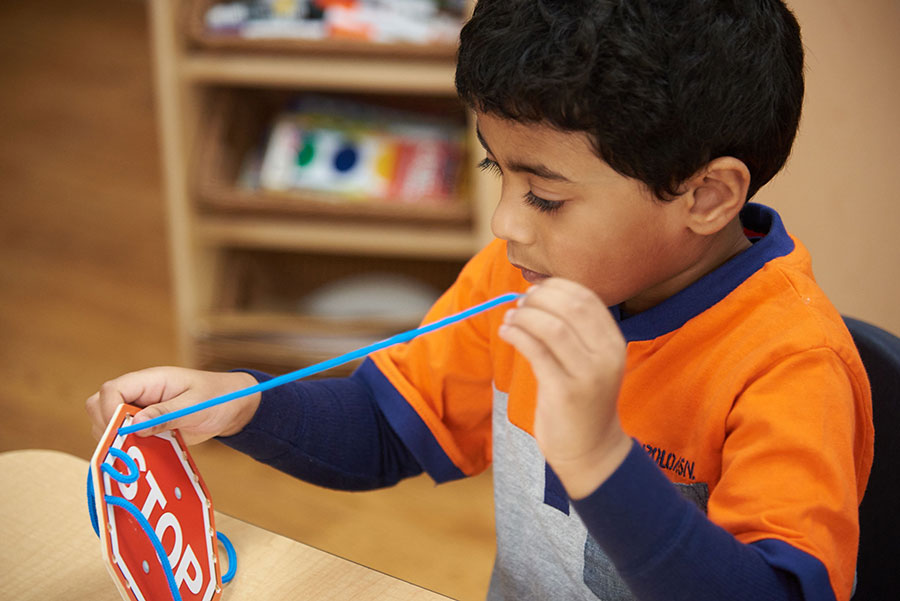


What defines STREAM?
- INTENTIONALLY incorporating one or more areas of learning into one activity
- Academic vs. Intellectual learning – creating opportunities that not only meet academic milestones but also target reasoning and critical thinking
- Active learning that starts by posing questions, problems, or scenarios – it’s piquing children’s interest and bringing out their natural curiosity about a problem or challenge
Here’s a closer look:
S – Science: Science activities include exploring water and sand, comparing and contrasting natural materials, rolling balls across the room, and every other act of discovery. It is:
- A way of thinking
- Observing, experimenting, predicting, discovering, and categorizing
- Asking questions and wondering
T – Technology: In our mind,s when we think of technology, we think about electronics, but we have to get used to viewing technology as a tool(s). Anything created by humans-designed to make tasks easier. For example, you could dig a hole using your hand, but it is much more efficient to use a shovel, which is a form of technology. Technology includes all tools, machines, utensils, instruments, communicating and transporting devices, and the skills by which we produce and use them. Technology also includes simple machines such as wheels, pulleys, and gears.
- A way of creating
- Using tools, being inventive, identifying and solving problems, and making things
- The tools of science
R – Reading: Repetition of a featured book has numerous benefits to children.
- A way of expanding thoughts
- Listening, prediction, problem solving, identification with character traits, and idea generation
- A way to foster collaboration and higher-level thinking
E – Engineering: Engineering in preschool often happens with blocks. Children are planning and designing structures with little/no teacher direction. This sparks their creativity and imagination.
- A way of doing
- Solving problems, using a variety of materials, designing, creating, and building things that work
- Products of science
A – Art: Art should be open-ended and not product-driven, which will allow for more imagination and creativity to play a role in the finished piece!
- A way of exploring through sensory experiences
- Drawing, painting, imagination, symbols, and representations of thoughts onto paper
- Way of expression
M – Math: Math is present in almost all learning areas. It’s combining ingredients to make a cake in dramatic play. It’s balance and building in blocks. It’s patterning and matching with table toys and puzzles, and so much more.
- A way of measuring
- Comparing and contrasting, counting, estimating, sequencing, patterning, exploring shape volume, and size
- The language of science
So why STREAM and not STEM?
Initially, when the STEM movement first started, many toy companies began making STEM kits, school systems and child care centers began implementing STEM products and activities into their lesson plans, but no one thought about how children or young learners would be curious and want to engage. The areas of STEM are logical and attract learners who are more left-brain focused. This includes analytical thinking, math properties, reasoning, logic, and numbers. All the areas that pique curiosity during Science, Technology, Engineering, and Math activities.
Now, STREAM engages more of the creative side of the brain, the right-brain learners that are guided by emotion, imagination, creativity, expression, and awareness. The specific addition of Art and Reading not only benefits all children, but also focuses on the development of the ‘whole-child’.